Will the monsoons come?
Will I help Grandpa
gather Saguaro fruit
and desert marigolds?
Will we look for horned toads
and gila monsters
near the arroyo?
Once more.
Yes, monsoons will come
to you and Grandpa
and to the horned toads
and gila monsters.
All will be there.
But now it is summer.
Now we lick
prickly pear popsicles.
So cool, so delicious.
Taste it.
I'm still using NOW IT IS WINTER, written by Eileen Spinelli for my mentor text. What is your favorite food to eat in summertime? Can you write a poem about summer foods today? Have fun writing.
It is Friday again and time for the Poetry Friday Round Up. A chance for you to read more poetry by children's poets. The Round Up is hosted by Jama Rattigan today at her blog Jama's Alphabet Soup. Hop over to the party and enjoy the poetry. Thanks, Jama for being the hostess with the mostess for us.
Reading children's poetry is a great way to build vocabulary.
Showing posts with label prickly pear. Show all posts
Showing posts with label prickly pear. Show all posts
Friday, June 12, 2015

Tuesday, August 19, 2014
Dear Friend,

Send me the song
of a cactus wren
trilling and hauntingly sweet.
By the tune
I will know
you are there, still
in the desert,
where wide skies unfurl
pink, purple, red;
where Saguaros rise
in benediction
and living is
a devotion.
I've been busy today making Prickly Pear jelly. I covered my arms with leather gauntlets and wore leather gloves, but still the spines went through my gloves and clothing. That is the hardest part of making the jelly. What is something hard or difficult for you to do? Can you write a hard poem today? (That was a little pun.) Do have fun writing your own poem.
Friday, April 18, 2014
A Pantoum
APRIL
April tosses her
hair.
This is how it
begins--
green willow
branches float the air
to dance in
springtime winds.
This is how it
begins
day after blowing
day
to dance in
springtime winds
as April has her
way.
Day after blowing
day
Spring reaches to
delight
as April has her
way
blowing clouds
black and white.
Spring reaches to
delight
giving us all
flower fun.
Blowing clouds
black and white
until her breath
is done.
Giving us all
flower fun
Prickly pear
blossoms visited by bees.
Until her breath
is done,
April collects
pollen on her knees.
Prickly pear
blossoms visited by bees
to dance in
springtime winds.
April collects
pollen on her knees
This is how it
begins.
A pantoum is one of the French forms, somewhat similar to the Malaysian pantum, but also attributed to English. The form weaves lines together. If you look closely you'll see the rhyming pattern of A1,B1, A2, B2 B1, C1, B2, C2, C1,D1, C2, D2 etc. until you come to the end stanza where the first and third lines are dictated by the previous stanza, and the second and fourth lines are a repeat from the first stanza (in reverse) of lines A2, A1; or B2, B1--or the poem can simply be concluded with a couplet of A2, A1. This information comes from THE SHAPE OF OUR SINGING by Robin Skelton, Eastern Washington University Press, 2002.
You might have fun trying this form. Or, just try writing four couplets about April or spring. Hey, and if you get that far, you can then try weaving the lines together and see what you come up with. Have fun playing with poetry.
When I previewed this poem, there was an extra space between the penultimate and the last line. I considered correcting the formatting error, but as I thought about it, I liked the line, This is how it begins, out there on its own. And it made me consider that this poem makes an interesting reverso--a poem that reads as well top to bottom as it does bottom to top. What do you think?
The Poetry Friday Roundup is hosted this week by Robyn Hood Black on her blog Life at the Deckle Edge. Hop over there for more poetry fun.
The Poetry Friday Roundup is hosted this week by Robyn Hood Black on her blog Life at the Deckle Edge. Hop over there for more poetry fun.
Wednesday, July 17, 2013
PRICKLY PEAR
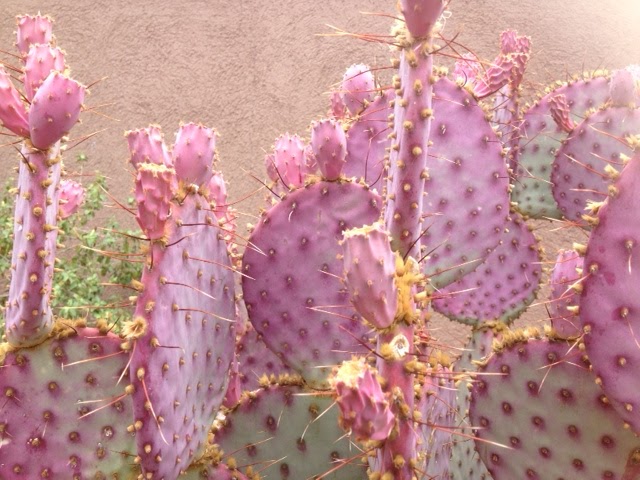
I'm working hard
doing the best I can.
I'm cooking up some
prickly pear jam.
It is sweet and tasty,
I don't want to boast,
but it tastes delicious
on my morning toast.
Making prickly pear jam isn't easy because there are lots of stickers to deal with. what is your favorite flavor of jam. I had friends give me strawberry jam and apple butter that they made from their own fruits. Homemade jam on toast tastes wonderful! Can you write a poem today about your favorite flavor of jam? Maybe you want to add peanut butter and write about a sandwich? Have fun playing with words as you cook up your own sweet poem.
Friday, March 29, 2013
Prickly Pear Cactus

Budlets
on the paddles
of the prickly pear
soon lush yellow and red flowers
then fruit.
Today's poem is a cinquain, a five line syllabric poem with 2 syllables in the first line, then 4, 6, 8, 2. Perhaps this chart will help:
Line 1 = 2 syllables
Line 2 = 4 syllables
Line 3 = 6 syllables
Line 4 = 8 syllables
Line 5 = 2 syllables
Your challenge for today is to try writing your own cinquain.
The cinquain is a nonce form invented by Adelaide Crapsey (1878-1914). The poem has 22 syllables compressed into five lines. If you enjoy this form, you might enjoy reading Lee Bennett Hopkins' anthology of cinquains, CITY TALK, (Knopf, 1970, photographs by Roy Arenella.) The poems are presented by seasons from children Hopkins worked with as a consultant for Bank Street College of Education in New York's Harlem schools.
Mary Lee Hahn is hosting the Poetry Friday roundup at http://readingyear.blogspot.com/


Subscribe to:
Posts (Atom)